The Scoreboard Fallacy: Why AEO Won't Save You From a Problem That Already Happened
AEO isn’t a new playbook—it’s the same game with the scoreboard harder to read. Zero-click was already the majority behavior before ChatGPT; AI just made the blindness undeniable. The crisis isn’t traffic. It’s visibility.
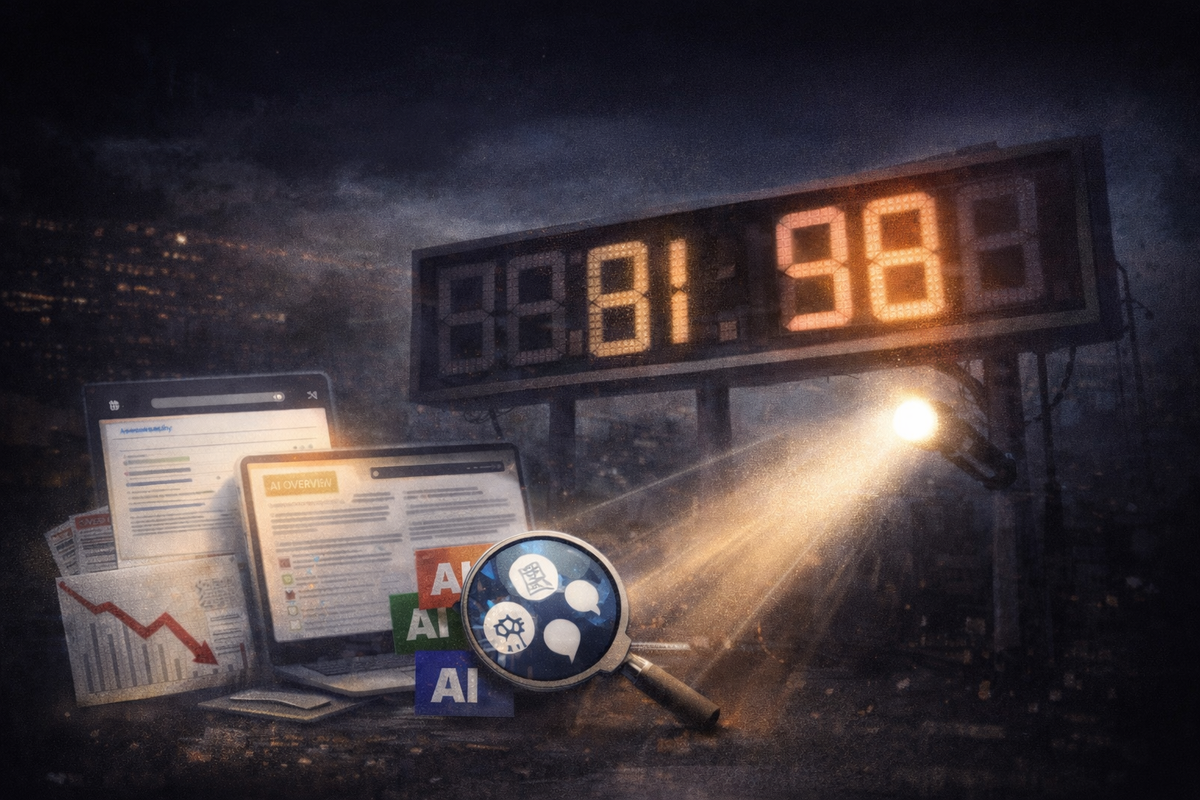
The marketing industry is treating Answer Engine Optimization like a new game. It isn't. AEO is the same game with a scoreboard you can no longer read. The traffic crisis everyone attributes to AI search already occurred—zero-click searches crossed 60% before ChatGPT existed. What AI did was turn off the lights.
You're not losing clicks to a new technology. You're losing the ability to see whether you're winning or losing at all.
The Myth
AI search is disrupting your traffic.
This is the consensus narrative: ChatGPT, Perplexity, and Google's AI Overviews are siphoning visitors away from websites, and companies must adopt radical new "AEO" tactics to survive. The framing implies a before-and-after—traditional SEO worked, then AI arrived, now everything is different.
The data demolishes this story.
ChatGPT handles over 2 billion queries daily—yet sends less than 0.5% of the web's traffic. The usage is massive; the click is non-existent. The "disruption" everyone is optimizing for isn't a traffic problem. It's a scoreboard problem wearing traffic's clothes.
The actual traffic disruption is a decade old. Zero-click searches hit 60% by 2023—before AI Overviews launched. AI didn't cause the collapse; it inherited one.
The Reality
The crisis is not traffic. The crisis is visibility into your own performance.
When AI Overviews appear, 83% of searches end without a click. Users read the synthesized answer, absorb the information, and leave. Your content succeeded—for the platform, not for you. And you'll never know it happened.
Your facts entered the answer. Your brand may have appeared. The user may have been influenced. The scoreboard shows zero.
I've seen this pattern repeatedly: organic traffic drops 15–20% while pipeline metrics hold steady or rise. Dashboards show decline. Revenue shows growth. The numbers stop making sense because the scoreboard is broken.
This is the dark funnel—and it's most of the funnel now. AI intermediation severs the connection between activity and measurement. The user never visits. The session never starts. The pixel never fires. But the outcome still occurs.
What feels new is not the behavior—it's the loss of plausible deniability. Before AI, marketers could pretend the invisible majority didn't matter because the visible minority kept clicking. Answer engines didn't change user intent. They removed the last excuse for ignoring it.
And someone is getting paid to pretend otherwise.
The AEO industry sells "new tactics" that are indistinguishable from old ones. Bing's official AI visibility guidelines recommend chunked content, descriptive headers, schema markup—standard SEO circa 2018. Research shows a 0.65 correlation between traditional Google rankings and AI citation rates. Seventy-six percent of URLs cited in AI Overviews already rank in the top 10.
If you're doing good SEO, you're already doing 80% of AEO. The consultants charging for "Answer Engine strategy" are selling you a rebrand of work you've already done—or should have. The remaining 20% is structural hygiene: answer-first formatting, FAQ schema, clean HTML. Table stakes, not transformation.
The Implication
The winning move is not a new strategy. It's accepting that your old scoreboard was always showing a partial score.
Traffic was never the full picture. It was the visible slice—the 30–40% of users who still clicked. The majority made decisions you couldn't track. AI didn't break the scoreboard. It revealed that the scoreboard was always incomplete.
You cannot fix a broken scoreboard. But you can build a new one.
The Artifact: The Citation Audit
Select 30 high-intent queries your customers actually ask—not keywords, questions. "What's the best CRM for teams under 50 people." "How does [Your Company] compare to [Competitor] on pricing." Run each across four platforms: Google AI Overview, ChatGPT, Perplexity, Bing Copilot.
Score each response:
- 0 points: Brand doesn't appear.
- 1 point: Mentioned but not linked.
- 2 points: Cited as a source.
- 3 points: Primary authority ("According to [Brand]...").
Maximum score: 360. If you score below 60, you are invisible to the answer layer. The users who never click are forming opinions without you.
Most companies will score poorly and discover their "SEO success" was always measuring the exception, not the rule.
The Game
The AEO panic has the causality backwards.
Companies believe: "AI is taking our traffic, so we need new optimization tactics."
The reality: "Most users stopped clicking years ago. AI just made our blindness undeniable."
You don't need a new playbook. You need to accept that the old playbook was always optimizing for a minority of user behavior—and that minority is shrinking.
If your scoreboard only shows 30% of the game, and that 30% is getting smaller every quarter, are you winning? Or are you just winning the part you can see while losing the part you can't?
The companies that thrive won't be the ones with the best AEO tactics. They'll be the ones who stopped trusting a scoreboard that was never showing the real score—and built for a game where the only evidence you're winning is that customers keep showing up for reasons your dashboard will never explain.