The Conductor's Paradox: How Engineering Management Prepared Me to Lead AI Agents
The moment you stop writing code is the moment you start designing outcomes. Most engineers experience this as a loss. It's actually preparation for a future that just arrived.
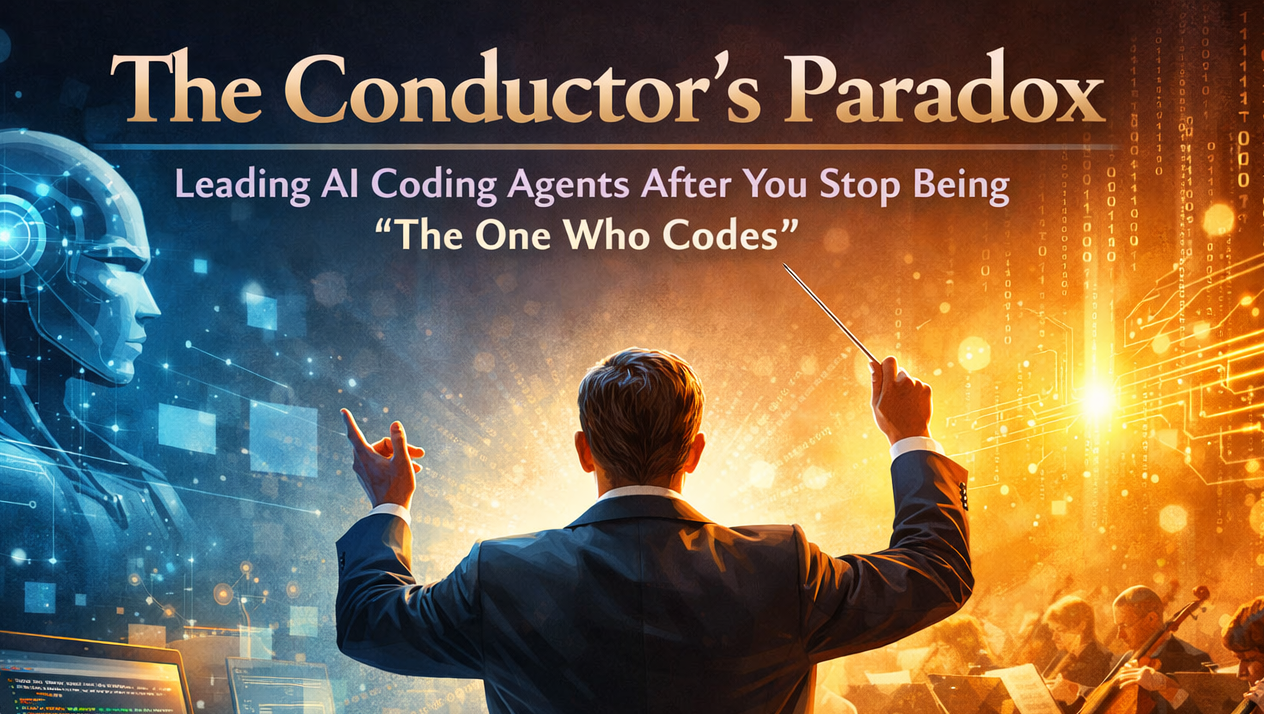
The moment you stop writing code is the moment you start designing outcomes. Most engineers experience this as a loss. It's actually preparation for a future that just arrived.
AI agents are forcing the same transition that engineering management forced years ago—except now everyone has to learn it at once.
The Observation
There's a grief in the engineer-to-manager shift that rarely gets named. It isn't missing the keyboard. It's the collapse of a comforting illusion: that your hands on the keys are what make things happen.
The first time a junior engineer ships a feature using an approach you'd never choose—and it works—something cracks. Users don't care about the elegance you would have demanded. They care that their problem disappeared. The architecture you would have insisted on didn't matter. The outcome did.
That's the moment you realize your value was never in the execution. It was in shaping the conditions that made good execution possible.
Lao Tzu wrote it twenty-five centuries ago: "When the best leader's work is done, the people say, 'We did it ourselves.'" He wasn't talking about engineering management. He was describing the fundamental physics of influence.
The Tension
Working with AI coding agents—Claude, Cursor, Copilot—should feel unfamiliar. A system that can propose, implement, and iterate. A different kind of mind doing the work. A collaborator who doesn't need breaks or context-switching time.
It doesn't feel unfamiliar. It feels like recognition.
In 2018, the other mind was a human you managed. In 2025, it's a system you direct. Different substrate. Same leadership problem: how do you give away execution without giving away responsibility?
That's the conductor's paradox. A conductor doesn't play a note. Yet the performance rises or falls by their ability to shape tempo, dynamics, and vision. They're accountable without being the instrument. They hold the outcome without holding the bow.
Engineering management was the training. AI agents are the exam.
The Deaths
Every engineer who becomes a manager dies three times.
The death of competence. Your identity was built on solving problems directly. Now you ensure problems get solved—often without touching them. The IDE grows quiet. Impostor syndrome whispers that you're merely overhead.
The death of certainty. Engineering trained you on deterministic loops: compile, run, test. Management is probabilistic. Decisions happen with incomplete information. Feedback arrives late. You act before you know.
The death of authorship. The shipped work isn't yours. Your name isn't on the commit. Satisfaction has to come from something harder to see: the conditions that made good work possible.
These weren't losses. They were preparing for a world in which execution is increasingly delegated and human value is concentrated upstream.
The Reframe
The highest-leverage skill in directing AI agents is one that bad managers never learn: intent over instruction.
L. David Marquet, commanding a nuclear submarine, realized that detailed orders created dependency. If he was wrong, everyone died. So he shifted. Instead of commands, officers stated intent: "Captain, I intend to submerge to avoid surface turbulence." He verified the thinking, not the task. He checked judgment, not compliance.
The same shift works with engineers. Instead of prescribing solutions, describe the problem's shape. Instead of rewriting code, ask questions until they find the issue. Instead of "do it this way," ask "what are you optimizing for?"
And it transfers directly to AI agents.
Instruction: "Write a function that filters inactive users, maps to emails, dedupes, and sorts alphabetically."
Intent: "I need unique email addresses from active users for a notification system. Show me a clean implementation and explain your reasoning on edge cases."
The first treats the agent like a typewriter. The second treats it like a capable collaborator. One limits judgment. The other invites it. The difference determines whether you get compliance or contribution.
The Paradox
The anxiety underneath all of this is simple: if AI can execute, what's left for me?
Donella Meadows argued that the highest leverage points in any system are its goals and paradigms—the purposes and mental models that shape everything downstream. The lowest leverage points are the parameters.
Writing code adjusts parameters. You're solving a problem someone else framed.
Leading—whether people or agents—operates at a higher altitude. You define what "good" looks like. You shape the goals. You question the paradigm. You hold the whole.
A conductor doesn't produce a sound. By the logic of individual contribution, they're useless. But the orchestra cannot perform without them. They hold the tempo, the dynamics, the vision of the piece. They're accountable for everything while playing nothing.
That's the role we're growing into. Not execution, but orchestration. Not doing the work, but designing the conditions that make good work inevitable.
The engineers who learned to manage—who survived the three deaths and discovered that influence operates through intent, not control—already have the skills this moment demands.
The rest of the industry is about to learn the same lesson, faster, with less patience for the transition.
The tools are new. The responsibility isn't.
You're not being asked to do less. You're being asked to operate at a higher altitude. The baton works the same whether the orchestra is human or artificial.
The question is whether you're willing to put down the instrument.