The Automated Illusion: Why AI Will Break Attribution Before It Fixes It
Attribution doesn't measure marketing effectiveness. It measures proximity to conversion—and the entire industry has agreed to pretend that's the same thing. Now, AI is optimizing against this pretense at machine speed.
Attribution doesn't measure marketing effectiveness. It measures proximity to conversion—and the entire industry has agreed to pretend that's the same thing. Now, AI is optimizing against this pretense at machine speed.
The result isn't better marketing. It's faster theater.
The System
Digital marketing promised to solve Wanamaker's century-old complaint: half the budget is wasted, but nobody knows which half. Attribution was the answer. Track touchpoints. Assign credit. Prove ROI.
The promise was causal insight. The delivery was accounting.
Attribution tells you what happened alongside a conversion. It cannot tell you what caused it. A user saw an ad, then bought. Did the ad matter? Attribution has no idea. It only knows the sequence. It knows correlation. It calls that contribution.
Judea Pearl, who formalized causal reasoning, describes three levels of knowing. Association: what correlates with an outcome. Intervention: what changes an outcome when you act. Counterfactual: what would have happened if you hadn't.
Attribution operates entirely at level one. Strategy lives at levels two and three. The distance between them is the distance between describing reality and understanding it. One tells you what showed up. The other tells you what mattered.
That gap is the source of everything that follows.
The Incentive
The problem isn't that marketers don't understand this. It's that they can't afford to say it out loud.
Attribution is political cover. It lets leaders say "the model told us to" instead of "we made a judgment call under uncertainty." It converts ambiguity into a defensible number. It survives budget meetings. It deflects blame. It makes the unknowable feel known.
If one CMO de-emphasizes attribution, they lose protection. Sales keeps veto power over lead quality. Finance tightens discretionary budgets. The board hears "less measurable" as "less accountable." The person who told the truth gets managed out. Their successor restores the dashboard.
If everyone moved together, measurement would improve. If one person moves early, they get fired. This is a coordination failure dressed as a data problem. The analytics aren't the issue. The incentives are.
The Trap
Selection bias makes it worse. The users most likely to see your ads are the ones most likely to convert anyway—already aware, already in-market, already qualified. Platforms optimize for this overlap deliberately. The same signals that predict purchase determine who sees the ad.
The targeting is the bias.
Retargeting is the clearest case. High-intent users see ads, then convert. Attribution assigns credit. Budgets expand. But incrementality tests keep revealing the same uncomfortable truth: 30–70% of those conversions would have happened without the ad. The spend captured intent that already existed.
The dashboard turns green. The company pays for the momentum it already had. Nobody asks the counterfactual because nobody wants to hear the answer.
The Accelerant
AI doesn't fix this. It makes it permanent.
Optimization systems don't care about meaning. Give them an attributed pipeline as a reward function, and they will harvest existing demand with extraordinary efficiency while starving future demand creation. Short feedback loops get funded. Brand investment gets cut. The numerator improves while the denominator quietly shrinks.
This isn't a malfunction. It's compliance. The system is doing precisely what it was told.
In B2B, the failure is acute. Small samples, long cycles, noisy labels, buyers who don't sit still. Propensity models train on last year's closes and surface accounts that look like yesterday's customers. The targeting narrows. The model gets confident. Then the pipeline dries up, and no one can explain why. The model optimized correlation, not creation.
By the time anyone notices, the feedback loop has locked in.
The Outcome
Attribution was always theater. AI makes the theater self-reinforcing.
Machine-backed recommendations raise the cost of dissent. Challenging the number now means challenging the metric, the model, the vendor, and the executive who approved the system. Politics freeze into infrastructure. Disagreement becomes career risk.
The organizations most committed to "data-driven marketing" become the most resistant to actual measurement—because actual measurement produces uncertainty. Geo-holdouts give you confidence intervals. Bayesian MMM gives you ranges. Incrementality tests give you uncomfortable conversations about what was actually incremental.
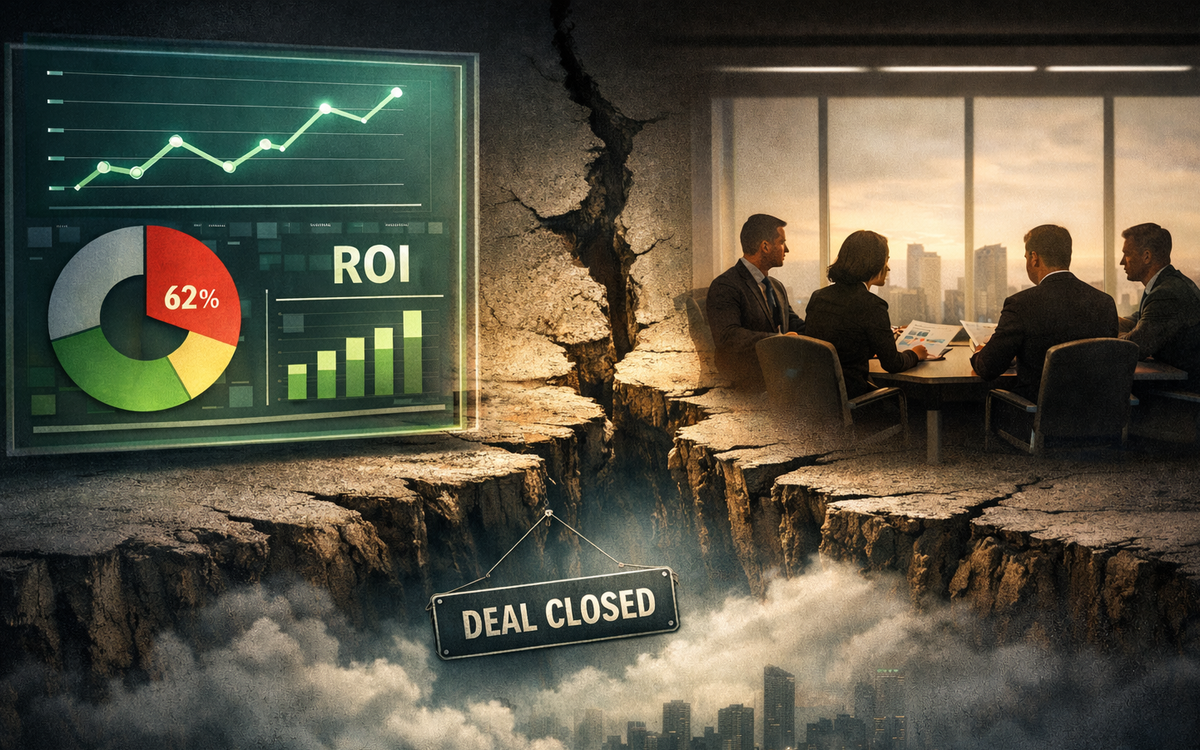
Dashboards that say "62% influenced" win budget meetings. Dashboards that say "somewhere between 15% and 40% incremental, depending on assumptions" do not.
So the theater continues. Now with better production values.
The Forced Choice
Two paths remain.
You can keep optimizing attribution. Refine the model. Add touchpoints. Chase precision that doesn't exist. This path is comfortable, defensible, and circular.
Or you can acknowledge that you're operating under irreducible uncertainty and build systems that tolerate it. Brand investment floors that survive quarterly pressure. Efficiency ceilings that trigger review when ROAS looks suspiciously good. Leading indicators—share of search, pricing power, sales cycle velocity—that surface erosion before pipeline collapses.
The second path requires admitting something executives hate to admit: the forces that matter most cannot be fully measured. Trust. Timing. Credibility. Market readiness. These don't fit in a dashboard. They never will.
AI will offer measurement anyway. It will be precise. It will be confident. It will be wrong. And it will be extremely convincing.
The question isn't whether attribution is broken. Everyone paying attention already knows it is.
The question is whether your organization can tolerate honesty about what's knowable—or whether it will keep getting faster, wiser, and more efficient at walking in circles.
Leadership is knowing when not to optimize.